Photoluminescent egress Markings are code required
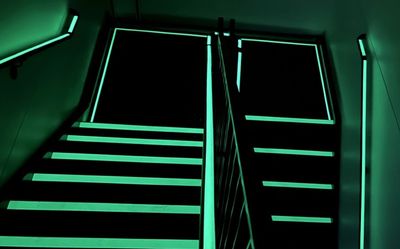
Required under IFC, IBC and NFPA Code
Photoluminescent (PL) Egress Markings in stairwells has been CODE REQUIRED for ~15 years.
International Fire Code (IFC) 2021
International Building Code (IBC) 2021
National Fire Protection Association Code 2021
Most qualified new construction projects have been incorporating the required photoluminescent markings since approximately 2011. This is a requirement in order to receive a final Certificate of Occupancy (COO). Existing buildings that have not planned to or actually installed photoluminescent egress markings are "out-of-compliance" with current IBC - IFC - NFPA code requirements. When extensive renovations are performed in existing buildings triggering the issuance of a new COO, the photoluminescent egress markings are a required safety upgrade.
What buildings require Photoluminescent Egress Markings?
International Building Code: Photoluminescent Egress Markings for exit
stairwells as required in Occupancy Groups A, B, E, I, M, and R-1 in accordance
with IBC Section 1025. These requirements apply to new and existing buildings
over 75 ft. tall.
Photoluminescent markings are required at the step edge, on handrails, landing perimeters and obstructions. All three Codes reference a minimum 1" wide marking stripe at each location but includes Exception: The minimum width of 1 inch (25 mm) shall not apply to outlining stripes listed in accordance with UL 1994.

CONFIDENCE. TOTAL CODE COMPLIANCE.
iLuminate Products carries the widest selection of Code Complaint products. From International Building Code to International Fire Code and every code in between: UL 1994, ASTM 2072, NFPA Life Safety 101 and US Green Building Council LEED. Total code compliant products makes selecting the best, most cost effective solution for any project easy because all your choices are certified code compliant for Photoluminescent Egress Markings in any environment.
Notable projects
Allston Labworks
Allston Labworks

Allston Labworks life sciences redevelopment program is anchored by the construction of approximately 514,900 square feet of office and research and development uses.
1 Congress Street
Allston Labworks
One Congress is a one-million-square-foot, trophy office tower located in the heart of downtown Boston.
Boston University Center for Computing & Data Sciences

The Boston University Center for Computing & Data Sciences is a 19-story structure featuring convention-bending design inside and out that makes it an iconic presence on Central Campus.
350 Boylston Street

This project consists of a 9-story mixed-use development with office and retail uses and a below-grade parking garage for approximately 150 vehicles.
Raffles Boston
Raffles Boston

A sleek addition to the city, Raffles Boston is the first North American property from the more than 135-year-old Raffles Hotels & Resorts brand.
We work with the majority of architects & General contractor

International Building Code Sec. 1025

General
Egress path markings shall be provided in exit enclosures,
including vertical exit enclosures and exit passageways.
Self-luminous and photoluminescent: Luminous egress path markings shall be permitted to be made of any material, including paint, provided that an electrical charge is not required to maintain the required luminance. Such materials shall include, but are not limited to, self-luminous materials and photoluminescent materials. Materials shall comply with either:
1. UL 1994; or
2. ASTM E 2072, except that the charging source shall be 1 footcandle (11 lux) of fluorescent illumination for 60 minutes, and the minimum luminance shall be 30 millicandelas per square meter at 10 minutes and 5 millicandelas per square meter after 90 minutes.
Step Edge Markings
Steps: A solid and continuous stripe shall be applied to the horizontal leading edge of each step and shall extend for the full length of the step. Outlining stripes shall have a minimum horizontal width of 1 inch (25 mm) and a maximum width of 2 inches (51 mm). The leading edge of the stripe shall be placed at a maximum of 1/2 inch (12.7 mm) from the leading edge of the step and the stripe shall overlap the leading edge of the step by not more than 1/2 inch (12.7 mm) down the vertical face of the step.
Exception: The minimum width of 1 inch (25 mm) shall not apply to outlining stripes listed in accordance with UL 1994.
Landings and Perimeter Markings
Landings: The leading edge of landings shall be marked with a stripe consistent with the dimensional requirements for steps.
Perimeter demarcation lines: Stair landings and other floor areas within exit
enclosures, with the exception of the sides of steps, shall be provided with solid and continuous demarcation lines on the floor or on the walls or a combination of both. The stripes shall be 1 to 2 inches (25 to 51 mm) wide with interruptions not exceeding 4 inches (102 mm).
Floor-mounted demarcation lines: Perimeter demarcation lines shall be placed
within 4 inches (102 mm) of the wall and shall extend to within 2 inches (51 mm) of the
markings on the leading edge of landings. The demarcation lines shall continue across the floor in front of all doors.
Wall-mounted demarcation lines: Perimeter demarcation lines shall be placed
on the wall with the bottom edge of the stripe no more than 4 inches (102 mm) above the finished floor. At the top or bottom of the stairs, demarcation lines shall drop vertically to the floor within 2 inches (51 mm) of the step or landing edge. Demarcation lines on walls shall transition vertically to the floor and then extend across the floor where a line on the floor is the only practical method of outlining the path. Where the wall line is broken by a door, demarcation lines on walls shall continue across the face of the door or transition to the floor and extend across the floor in front of such door.
Exception: Demarcation lines shall not extend in front of exit doors that lead out of an exit enclosure and through which occupants must travel to complete the exit path.
Exception: The minimum width of 1 inch (25 mm) shall not apply to outlining stripes listed in accordance with UL 1994.
Obstruction Markings
Obstacles: Obstacles at or below 6 feet 6 inches (1981 mm) in height and projecting more than 4 inches (102 mm) into the egress path shall be outlined with markings no less than 1 inch (25 mm) in width comprised of a pattern of alternating equal bands, of luminescent luminous material and black, with the alternating bands no more than 2 inches (51 mm) thick and angled at 45 degrees (0.79 rad). Obstacles shall include, but are not limited to, standpipes, hose cabinets, wall projections and restricted height areas. However, such markings shall not conceal any required information or indicators including, but not limited to, instructions to occupants for the use of standpipes.
Exit Doors in Egress Pathways
Doors from exit enclosures: Doors through which occupants within an exit enclosure must pass in order to complete the exit path shall be provided with markings complying with Section 1025.
Emergency exit symbol: The doors shall be identified by a low-location
luminous emergency exit symbol complying with NFPA 170. The exit symbol shall be a
minimum of 4 inches (102 mm) in height and shall be mounted on the door, centered
horizontally, with the top of the symbol no higher than 18 inches (457 mm) above the
finished floor.
Door hardware markings: Door hardware shall be marked with no less than 16
square inches (406 mm2) of luminous material. This marking shall be located behind,
immediately adjacent to or on the door handle and/or escutcheon. Where a panic bar is
installed, such material shall be no less than 1 inch (25 mm) wide for the entire length of
the actuating bar or touch-pad.
Door frame markings: The top and sides of the door frame shall be marked
with a solid and continuous 1 inch to 2 inch (25 mm to 51 mm) wide stripe. Where the door molding does not provide sufficient flat surface on which to locate the stripe, the stripe shall be permitted to be located on the wall surrounding the frame.